Most traders can tell you what they traded. Almost none can tell you why.
It feels natural to sell on a support break. Yet at the same candle, someone else is buying. Same chart, opposite decision. One of you is guessing.
Here's the uncomfortable part: without a record, next week you won't remember which one you were. That's the whole problem a trading journal solves.
What Is a Trading Journal? (Short Answer)
A trading journal is a structured record of your trades that captures the reason, plan, emotions, and result behind each one — not just the entry and exit prices.
In simple words: it is your curated trading experience, kept in a form you can actually review later.
And before the confusion starts — "trade journal", "trading journal", and "trading diary" all mean the same thing. Different words, same job. Don't overthink the label.
What a Trading Journal Really Is
Many people think a trading journal is only a list of trade entries —
"Buy here, sell there, stop loss here."
That's not entirely true.
A trading journal is simply: your curated experience — structured, organized, and reviewable.
It records the reason, mindset, emotion, context, and lesson of each trade — all in one place.
It is an invisible tool that helps you understand:
- What are you doing?
- Why are you doing it?
- Where do you make mistakes?
- What are your strong points?
Look — imagine you have 1,000 trades recorded. You won 700, you lost 300. Sounds like a solid 70% win rate. Then you read the journal back and see only 3 setups actually drove the profit — the other setups roughly cancelled each other out. Without the record, you'd keep taking all of them. With it, you know exactly which three to trust next time a setup appears.
It's the map of your evolution as a trader, especially when you keep the notes inside Traders Journal where every trade lives next to its context.
What a Good Trading Journal Tracks
Most people think a journal is only about the entry and the exit.
A real one goes deeper. It captures your entire state — from the moment you think of the trade, to the moment you close it, to the moment you learn from it.
A good journal doesn't just track numbers. It tracks you. Break it into three phases.
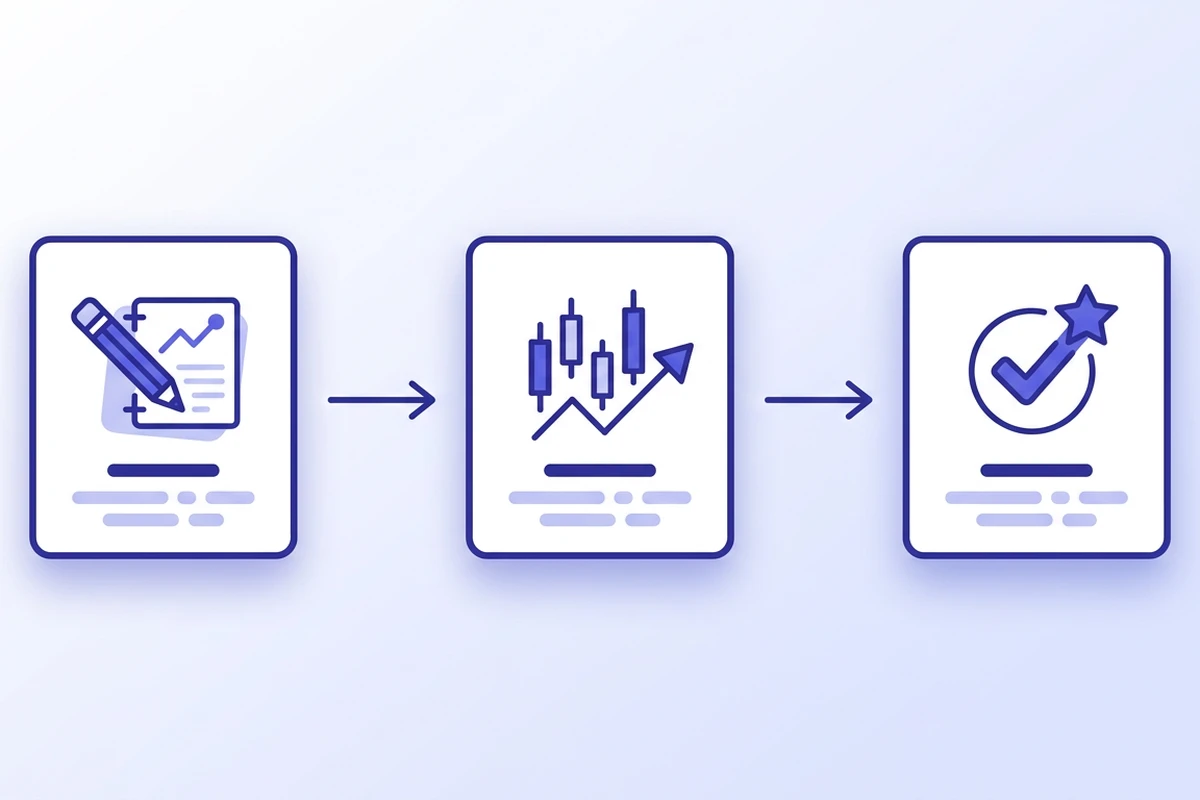
1. Pre-Trade Notes (Before You Take the Trade)
This is everything you write before entering.
Capture:
- The setup and why it qualifies
- Your entry, stop, and target levels
- Expected risk-to-reward
- A chart screenshot of the plan
Why this matters: pre-trade notes show whether you followed your strategy or acted on impulse. Over time they give you clean data you can trust.
2. Entry Details (When the Trade Goes Live)
Record the exact facts: entry price, entry time, quantity, and direction.
Why this matters: clear entries let you calculate real metrics — win rate, average risk-to-reward, position sizing, overall efficiency. Without them, you're guessing about your own performance.
3. Post-Trade Review (After the Trade Closes)
This is the honest part: your emotions, whether you followed your rules, what went right, what went wrong, and a screenshot for context.
Why this matters: this is where learning happens. It shows your emotional patterns and the habits that keep costing you. With notes and screenshots, you can see exactly why a trade worked or failed.
Post-Exit Review: Did You Exit Too Early or Too Late?
A post-exit review checks whether you closed too early or too late by looking at what price did right after you closed the trade. Most journals stop at the result — a useful one checks this too.
Pull up the chart a day or two later and look past your exit candle. Did price keep running in your direction for another leg? You exited early — fear took the wheel before the plan did. Did it reverse right after you closed? You exited on time, even if it felt shaky in the moment.
Do this for twenty trades and a pattern shows up fast: most traders either flinch out early on every winner, or hold every loser hoping it turns around. Either one is fixable once you can see it written down instead of guessed from memory.
Types of Trading Journals
There is no single "correct" journal. There are trade-offs. Here are the three most common ways traders keep one.
1. Spreadsheet (Excel or Google Sheets). The classic starting point. Free, flexible, familiar.
What works well
- Free and available right now
- Fully customisable columns
- Good for raw numbers and simple stats
What could be better
- Screenshots and notes get messy fast
- Every stat is a manual formula
- Easy to skip when you're busy
2. Notebook or notes app. Great for thoughts and emotions, weak for data. Hard to review a month of trades and spot a pattern.
3. Dedicated trading journal app. Built for the job. Charts, notes, screenshots, tags, and stats sit together, and the metrics calculate themselves. See our full breakdown of the best free trading journal software if you're comparing options.
What works well
- Notes, screenshots, and stats in one place
- Automatic metrics — no manual formulas
- Tags and filters make review fast
What could be better
- One more tool to learn
- Best features often sit behind a paid plan
Honest take: start wherever you'll actually be consistent. A spreadsheet you fill in beats a fancy app you ignore. But once you have a few hundred trades, doing it by hand starts to hurt.
Trading Journal vs Spreadsheet: Quick Comparison
| What you need | Spreadsheet | Trading journal app |
|---|---|---|
| Basic P&L and win rate | Fine, once formulas are set up | Automatic, no setup |
| Chart screenshots per trade | Clunky — pasted images bloat the file | Built in, attached to the trade |
| Tagging setups to find patterns | Manual filtering, gets slow | Tag and filter in a click |
| Cost to start | Free | Usually free, paid tier for more |
Neither is wrong. A spreadsheet is enough for your first hundred trades. It starts costing you time once screenshots and tags become part of the routine.
Trading Journal Examples
Two real entries — a winner and a loser — show the format better than any explanation. Nothing fancy, just enough context to review it later.
Example 1: A winning trade.
| Setup / reason | Pullback to 20 EMA in an uptrend, bullish engulfing candle |
|---|---|
| Entry | Long @ 1,842.5 — 09:48 — 50 shares |
| Stop / target | Stop 1,828 · Target 1,875 · R:R ≈ 1:2.3 |
| Result | Exit 1,871 — +1.9R |
| Emotion | Calm at entry, itchy to exit early near target |
| Lesson | Plan worked. Nearly cut it short out of fear — trust the target next time. |
See the difference? The numbers tell you what happened. The emotion and lesson tell you why. That's the part a plain trade list throws away.
Example: A Losing Trade
The winners are easy to log. The value is in logging this one honestly too.
| Setup / reason | Breakout above resistance on rising volume |
|---|---|
| Entry | Long @ 612.4 — 10:15 — 30 shares |
| Stop / target | Stop 604 · Target 632 · R:R ≈ 1:2.3 |
| Result | Stopped out @ 604 — -1R |
| Emotion | Chased the breakout late, entered on the second candle instead of the first |
| Lesson | Breakout failed, but the real mistake was the late entry — the setup itself was still valid. |
A plain trade list would just show "-1R" here. The journal shows the loss was an entry-timing problem, not a bad setup — the kind of detail that only shows up when you write it down.
How to Start a Trading Journal
Keep it simple, or you'll quit by week two. Five steps:
- Pick one place. A sheet, a notebook, or an app. One. Not five tabs you'll never open again. Grab our free trading journal template if you want a spreadsheet ready to go.
- Write the plan before you enter. Setup, levels, risk-to-reward. If you can't explain it, that itself is a signal.
- Log the entry when it's live. Price, time, size, direction. Ten seconds.
- Review after it closes. Result, emotion, what you followed or broke, one screenshot.
- Read it back weekly. This is where the value hides. Look for repeats — good and bad.
Do this for every trade for a few weeks. Patterns show up faster than you'd expect.
How Often Should You Review It?
Weekly, at minimum. A quick Sunday read-back of the week's trades is enough to catch a habit before it becomes a pattern — three early exits in a row, or every loss coming from the same setup.
Do a longer review monthly. Pull up every trade, sort by setup, and check which ones actually made money versus which ones you just liked taking. Quarterly, zoom out further — is the strategy itself still working, or has the market changed underneath it? Journaling daily and never reading it back is the same as not journaling at all. The record is only useful once you look at it.
Common Trading Journal Mistakes
Most journals fail for the same few reasons. Avoid these:
- Only logging winners. The losers hold most of the lessons. If your journal only has winners, congratulations — you invented fiction.
- Recording numbers, skipping context. Price without reason and emotion tells you nothing later. "-1R" doesn't tell you if the setup was bad or the execution was.
- Never reading it back. A journal you don't review is just a diary you don't read. The value is entirely in the read-back, not the writing.
- Being vague to protect your ego. "Market was bad" is not a reason. Be honest, mate — the journal only works if you don't lie to it.
- Making it so heavy you quit. Twenty fields per trade sounds thorough. You'll last a week, then quietly stop, then feel bad about quitting instead of just simplifying it.
- Journaling the trade but skipping the exit. Most traders record entries carefully and forget the exit was a decision too — see the post-exit review section above.
Why Journaling Changes Everything
Short version: journaling turns trading from a series of guesses into a process you can review, correct, and repeat. Here's the longer version.
Imagine you're deep inside a jungle. No paths, no signs, no idea where you came from. That panic hits — "How do I get out?"
Then you check your bag and find a map. You're still in the jungle, but now you know where you are, where you went wrong, and how to move forward.
A trading journal is that map.
Most traders walk the markets like that lost explorer — guessing, hoping, reacting. Traders who journal move with clarity. They know:
- What they do that makes money
- What they do that loses money
- Which market conditions suit them
- Which setups are worth repeating
- What mistakes keep showing up
As the saying goes: "You can't improve what you don't measure." For another take, this trading journal best practices guide shows how disciplined traders keep their records.
None of this promises profit. It won't. What it does is turn "getting better" from a hope into a process — real numbers, clean notes, and patterns you can actually act on.
This isn't a retail-only habit either. Prop desks and funded traders are usually required to keep one — a review process is part of the job, not optional homework. The gap is that retail traders treat it as optional, then wonder why the same mistake shows up every few months instead of once. Most of what a journal actually fixes is psychological, not technical — see CME Group's trading psychology course if you want to go deeper on that side of it.
How Traders Journal Helps
Every trade carries its own story — the emotion behind it, the logic you used, the context of the market.
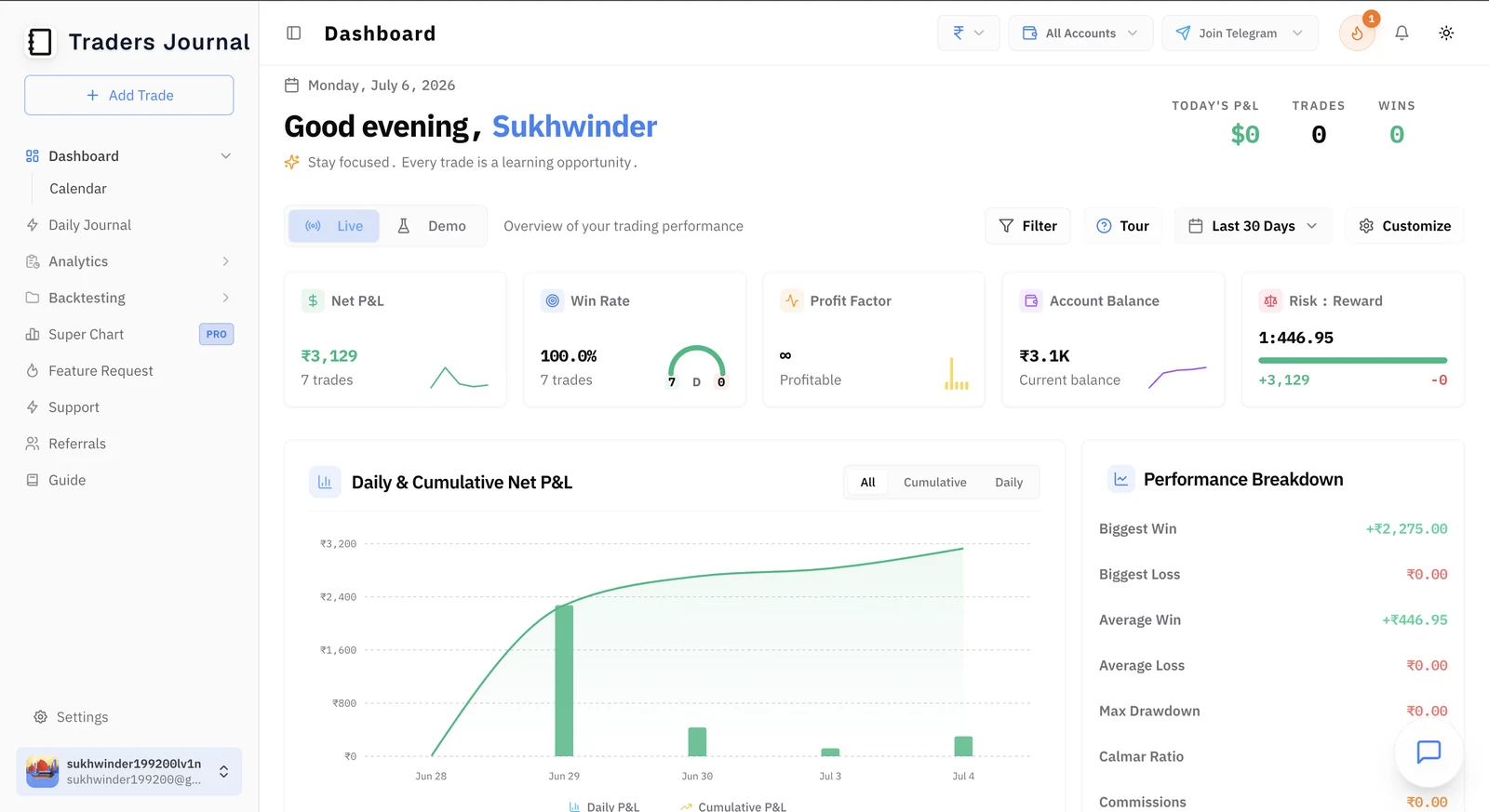
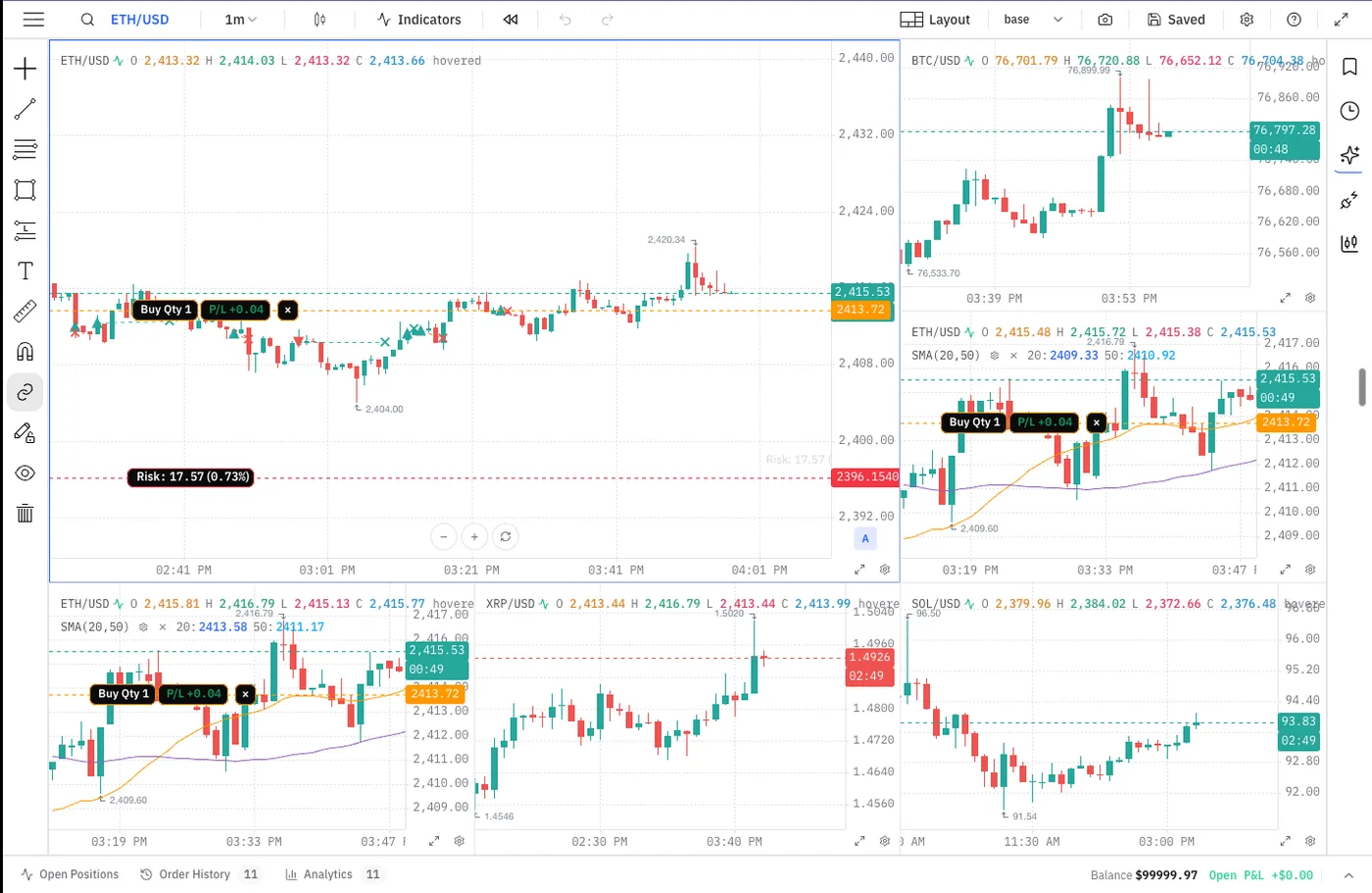
We built Traders Journal to keep that whole story in one place — chart, journal, backtest, and review, without switching between five tools. Roughly 3,600+ traders use it today.
Inside, you get live charting, a trade journal with tags and screenshots, a dashboard with your stats, backtesting with bar replay, and AI insights that flag your patterns and mistakes. There's a free forever plan to start, and premium is $12 / ₹499 a month if you want the full set.
You focus on trading. Traders Journal handles the heavy work in the background.
👉 Start your free trading journal today at TradersJournal.app. As a low-risk first step, import last week's trades and see how it feels. Simple, fast, and free.