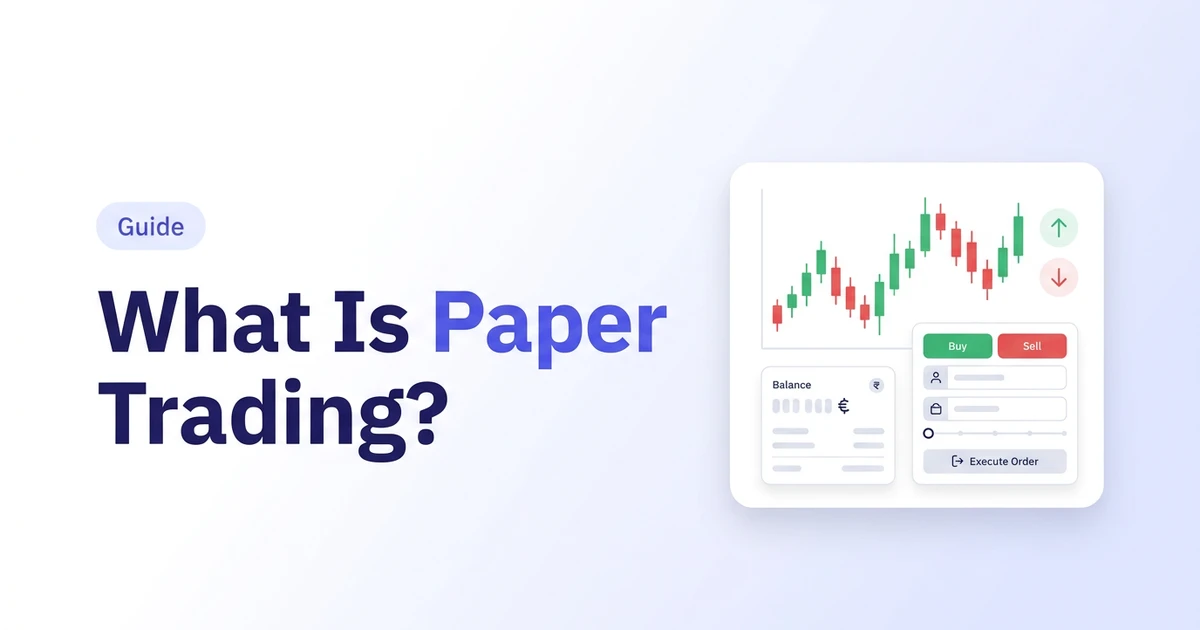
Paper trading is practising trades with virtual money on real or past prices, so a mistake costs you nothing. The name is a leftover from the days when traders wrote their practice trades on paper. Today it means a demo account or a simulator, and it is the cheapest way to learn the order ticket. The catch is sample size: in our own test, one simple rule gave win rates from 30% to 67% over 30 trades. To try it, open our paper money trading simulator.
Start free, no card
Log every trade, tag your setups and see what's working. The free plan stays free.
How Paper Trading Works
- You open a demo account or simulator with a virtual balance, often $10,000 to $100,000.
- You pick a market and place orders with an entry, a stop and a target, just as you would live.
- The simulator fills them against real prices and keeps score of your profit and loss.
No broker takes your money, and no broker gives you any. It is a flight simulator for trading: the plane is pretend, the buttons are real.
Live Paper Account vs Replay
| Kind | Prices | Pace | Best for |
|---|---|---|---|
| Live paper account | Today's market | Real time: you get what the market gives you | Learning the platform and sitting through slow mornings |
| Replay simulator | Past sessions, next candle hidden | As fast as you click, up to 200x on ours | Building a pile of trades quickly |
Both are paper trading. If you chart on TradingView, here is how to paper trade on TradingView, and the best paper trading simulators guide compares the tools. For intraday practice, try a fake day trading simulator.
What It Is Good For, and What It Misses
- Good for: learning the order ticket, testing a rule, and making your first mistakes for free.
- Misses fear and greed. A virtual balance does not make your hands shake.
- Fills are cleaner. A sim often fills at the price on screen. A live order can fill worse.
- Fees are often skipped. Many simulators, ours included, do not model commissions or slippage, so a practice profit looks slightly better than a live one.
Start free, no card
Log every trade, tag your setups and see what's working. The free plan stays free.
How Many Paper Trades Before You Trust It?
Fewer than you think prove nothing. We tested one plain rule on NAS100 with 15-minute OANDA candles from 4 January 2021 to 18 November 2026: take the first 15-minute candle, starting between 10:00 and 11:15 New York time, that closes outside the opening 30-minute range, put the stop on the other side of the range, and aim for a profit equal to the risk (1R). That gave 969 setups, of which 558 hit the target or the stop by the close (283 wins, 275 losses). The overall win rate was 50.7%.
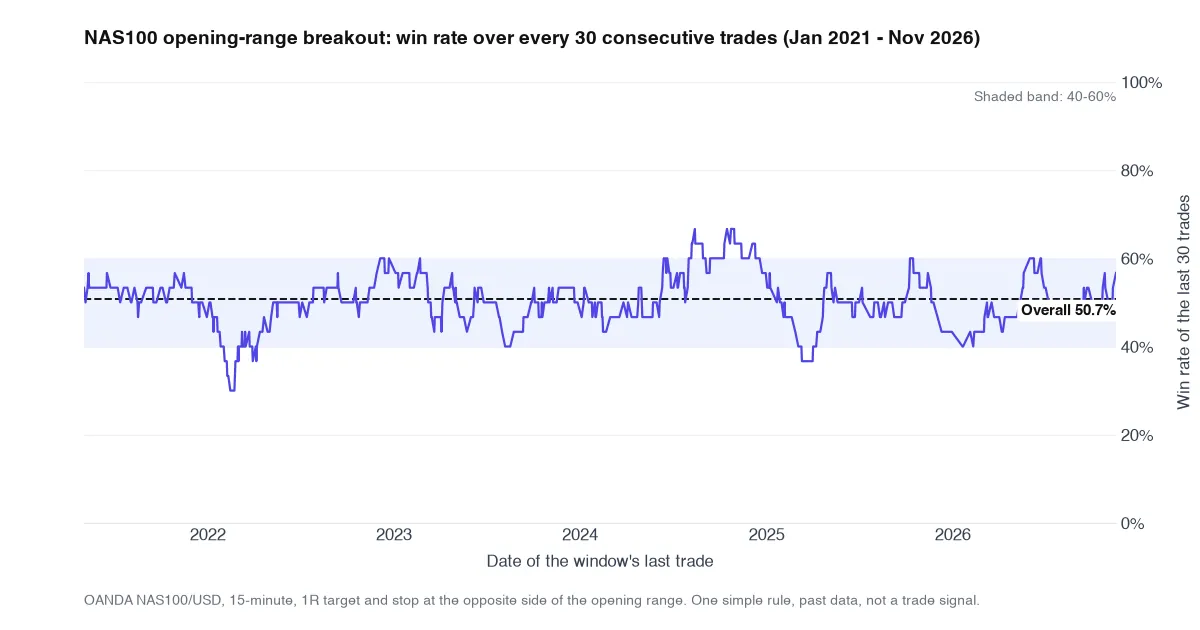
Now look at any 30 trades in a row. Across 529 overlapping windows of 30 trades, the win rate ranged from 30.0% to 66.7%. About one window in ten (10.0%) showed 60% or better, and nearly one in eleven (8.7%) showed 40% or worse. Same rule, same market. Paper trade it for 30 trades and you might have concluded you had an edge, or no hope at all, depending on the week.
| Over 30 trades | Win rate |
|---|---|
| Worst window (ended 14 Feb 2022) | 30.0% |
| Median window | 50.0% |
| Best window (ended 13 Aug 2024) | 66.7% |
Our test, OANDA bid prices, no spread or fees. Opening range: first 30 minutes of the New York open, one setup per day at most. Trades that hit neither stop nor target by the 16:00 close (411) were left out. If both were touched in one candle, it counted as a loss. Days missing more than 8 of 96 candles were skipped, which removes every Friday, so this is a Monday to Thursday sample. Windows overlap, so they are not independent samples. It shows noise for one simple rule, not a strategy.
A handful of practice trades is a coin flip you mistake for skill. That is why replay matters: it gets you a bigger sample in days, not months.
How to Paper Trade in 4 Steps
- Write the rule first. Entry, stop, target and size, in one sentence each.
- Size like your real account. If you will trade $5,000, practise with $5,000.
- Take enough trades. Replay past sessions to build a sample in the hundreds, then check it on more history with backtesting.
- Journal every trade. Why you took it, where you hesitated. The log is what turns practice into learning.
Trading futures? See the free futures trading simulators compared. More guides, plus the backtesting tools, are on the Traders Journal blog.