A forex demo account works by giving you a virtual balance, usually $10,000 to $100,000, and connecting it to live or near-live prices. You place trades the same way you would on a real account: pick a pair, set an entry, a stop and a target, and the simulator fills the order and updates your virtual balance. No broker takes your money, and none gives you any. It is a flight simulator for trading: the plane is pretend, the buttons are real. To try one, open our paper money trading simulator.
How a Forex Demo Account Actually Works
- You register with a broker or simulator, usually just a name and email, and get a virtual balance.
- The platform streams live or near-live prices for whichever pairs it supports.
- You place an order, market or limit, with a stop and a target, exactly as you would live.
- The simulator fills the order against the price feed and simulates the spread and any swap fee.
- Your virtual balance moves in real time as the trade runs, and the platform logs the result.
Most demo accounts run on the same software as the live account, MT4, MT5, cTrader, or the broker's own platform, so the screen you practise on is the screen you will actually trade on. That part is genuinely useful. The part that quietly stops being useful is everything downstream of the fill.
Say that in practice: you open EUR/USD, see 1.0850, click buy, and the fill shows 1.0850 or close to it, instantly. The platform logs the entry time, the size, the stop, and the target, and updates your balance as the price moves. Nothing about the ticket is fake. What is fake is what happens to you while you are looking at it.
Order Ticket Fields on a Demo Account
A demo order ticket usually includes the same fields as a live one:
- Market order. Buy or sell right now, at whatever price is showing.
- Limit order. Buy or sell only at a price you set, or better.
- Stop order. Triggers a market order once price reaches your level.
- Stop-loss and take-profit. Attached to the trade so it closes itself at your levels.
- Position size. Lots, units or contracts, whichever your platform uses.
Demo vs Live: What Is Actually Different
| What | Demo account | Live account |
|---|---|---|
| Money | Virtual. Cannot be withdrawn. | Real. Wins and losses are real. |
| Execution | Usually instant, at the price shown. | Depends on liquidity and your broker. Slippage happens. |
| Costs | Spreads and swaps are simulated, not always exact. | Real spreads, commissions and swap fees, every time. |
| Psychology | Mostly absent. Nothing real is at stake. | Fear and greed show up and change your decisions. |
| Purpose | Learn the platform, test a rule mechanically. | Trade for a real outcome. |
None of this makes a demo account pointless. It makes it a different tool than people think it is. A demo account is closer to a cockpit simulator than to a test flight: you learn every switch and every checklist, but the simulator will never make your stomach drop the way real turbulence does.
What a Demo Account Can Teach You
- The platform. Where the order ticket is, how to set a stop and a target, what a margin call warning looks like before it costs you anything.
- Order types. Market, limit, stop orders, and how they actually fill, not just how they are described.
- Position sizing. You can practise sizing a trade from your stop distance without the fear of getting the maths wrong on real money the first few times.
- Whether you can follow your own rules. Mechanically, at least. The hard part is what comes next.
- The habit of logging a trade. Writing down entry, exit, size and reason is a habit worth building before money is on the line, not after.
What Else You Can Practise on Demo
Beyond the ticket itself, a demo account is also where you can practise:
- Reading margin and leverage warnings before they cost you anything.
- Using chart tools and indicators without the fear of misclicking on a live order.
- Setting price alerts and getting used to your platform's mobile app.
- Building a watchlist of the pairs you actually plan to trade.
What a Realistic First Week Looks Like
Skip the thirty-trades-a-day habit. A realistic first week on demo looks closer to this: open the platform, set your balance to your real budget, and write your entry, stop, target and size for one setup before you place anything. Take the trade when it shows up, not before. Log it the moment it closes: entry, exit, size, result, and one line on how you felt pulling the trigger. Most weeks you will get somewhere between five and fifteen trades on one setup, which is still a glimpse, not a verdict. That is fine. The point of the first week is not proof, it is rhythm: can you follow your own ticket without improvising halfway through?
By the second or third week, the platform itself should feel boring. That boredom is the signal you are ready to stop practising the screen and start practising the decision.
What a Demo Account Cannot Teach You
A demo balance does not make your hands shake. That is the honest reason demo results and live results drift apart, more than any spread or execution difference. Mate, I have watched my own demo numbers look calm and confident, then watched the same setup feel completely different the first week real money was on the line. It is what it is: a $10,000 virtual loss and a $10,000 real one are not the same event, even though the chart looks identical.
- Fear and greed. Nothing real is at risk, so the pressure that causes overtrading, moving stops, and revenge trades is mostly missing.
- True execution. A demo fill is often cleaner than a live one, especially in fast markets.
- Whether the rule actually has an edge. A demo account shows you a handful of trades over a few weeks. That is not enough to separate a real edge from a lucky streak.
- What it feels like to hold a loser. On demo, closing a losing trade costs you a number on a screen. Live, it costs you the urge to move the stop "just this once."
Why Demo Quotes Do Not Always Match Live Quotes
A demo server and a live server are not always fed by the same liquidity pool. Most of the time the difference is small, a fraction of a pip here, a slightly tighter spread there. During fast news moves it can widen, because a broker's live desk deals with real order flow and real slippage, while a demo server often just marks the price and fills you at it. That is exactly why a strategy that looks clean on demo during a high-volatility event deserves a second look before you trust it live. None of this is a reason to distrust a demo account. It is a reason to treat its numbers as a guide, not a guarantee. If a setup only works because of a fill you would never get live, that is useful information too. It tells you the edge lives in the fill, not in the idea.
A demo quote is most likely to drift from a live one when:
- A major news release hits during low liquidity, such as late in the New York session.
- You trade a pair your broker quotes thinly on its demo server.
- The market gaps over a weekend or a holiday close.
Is Demo Trading Leverage Different From Live?
Often, yes, and it is one of the quieter ways a demo account can mislead you. Some brokers default demo accounts to higher leverage than they will actually approve on a live account, especially for smaller deposits. Higher leverage lets you open bigger positions for the same account size, which can make a strategy look steadier on demo than it will feel once your live leverage is lower and your position sizes have to shrink to match.
- Check the demo account's leverage setting against what your broker actually offers live for your region and account size.
- If they differ, resize your demo positions to match the live leverage before judging the results.
- Ask the broker directly if the demo leverage is not disclosed on the account summary.
Can You Actually Lose Virtual Money, and Does It Matter?
Yes, mechanically. A losing trade subtracts from your virtual balance exactly as it would live, and a bad enough run can wipe the account down to zero, the same as a live margin call. What changes is the consequence. Losing the virtual balance costs you a reset click. Losing the equivalent live balance costs you money you cannot get back by clicking anything. Both numbers can look identical on the chart. Only one of them changes how you feel about the next trade.
How a Demo Account Handles News and Volatility
This is where demo and live diverge the most. During a calm market, a demo fill and a live fill usually look nearly the same. During a high-impact news release, a live broker's desk deals with a flood of real orders, and spreads widen or slip because real liquidity is genuinely thinner for a few seconds. A demo server often just marks the price and fills you at it, without reproducing that stress. A strategy that trades through news on demo can look clean for exactly this reason, and then behave differently the first time you run it live into the same kind of release.
Demo Account vs Backtesting: Which Teaches You More
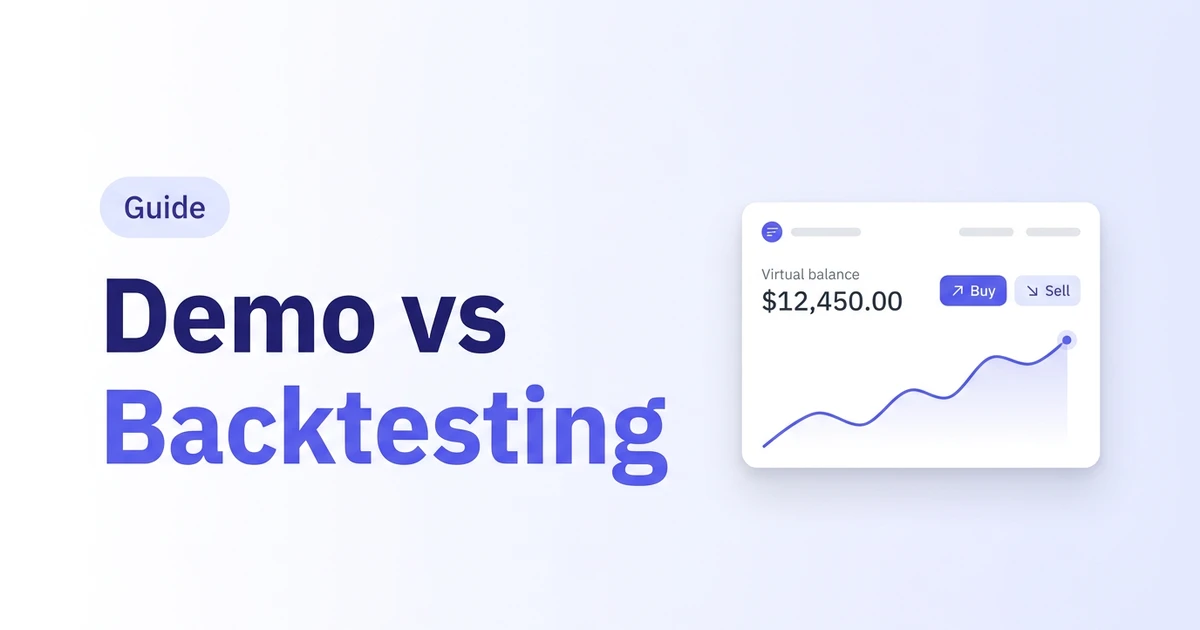
These two get confused constantly, and they answer different questions. A demo account answers: can you operate the platform and follow your own rules in real time? Backtesting answers: does this rule actually make money, tested across enough trades and enough market conditions to mean something?
| Method | Main job | Sample size you get |
|---|---|---|
| Demo account | Learn the platform, practise execution and sizing in real time. | A handful of trades a week, at real-time speed. |
| Backtesting | Test whether a fixed rule has an edge across history. | Years of data, hundreds of trades, in minutes. |
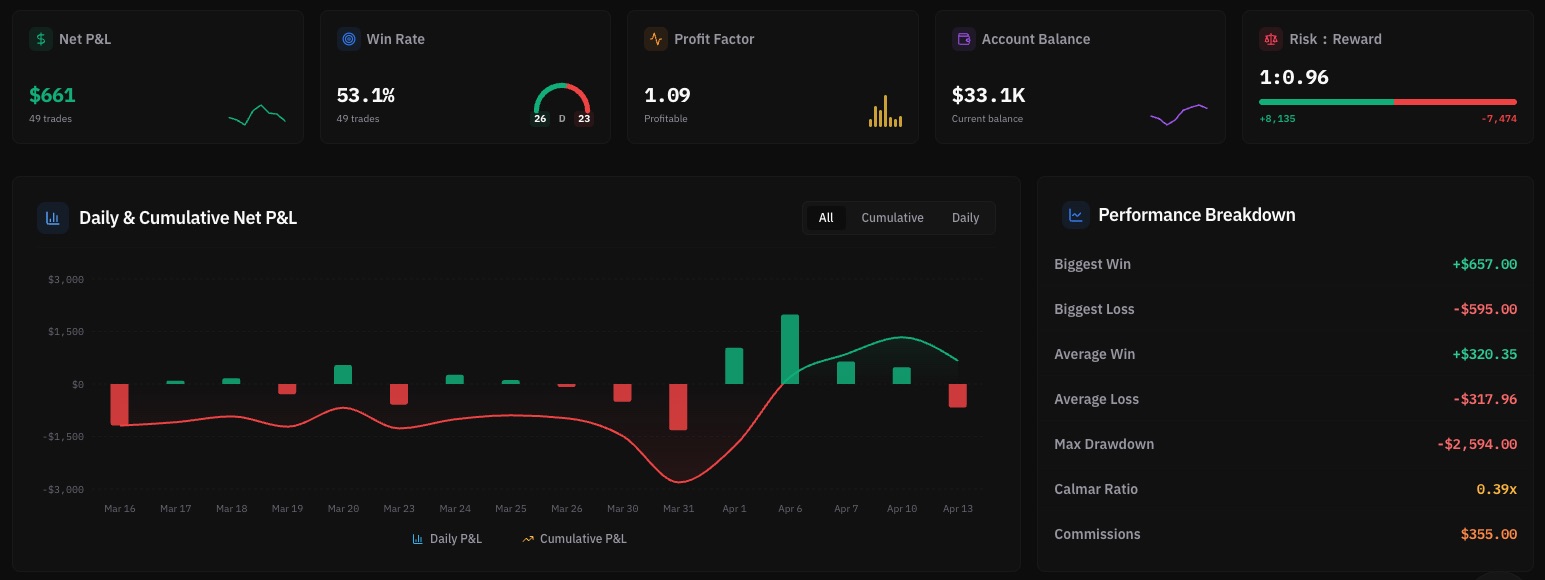
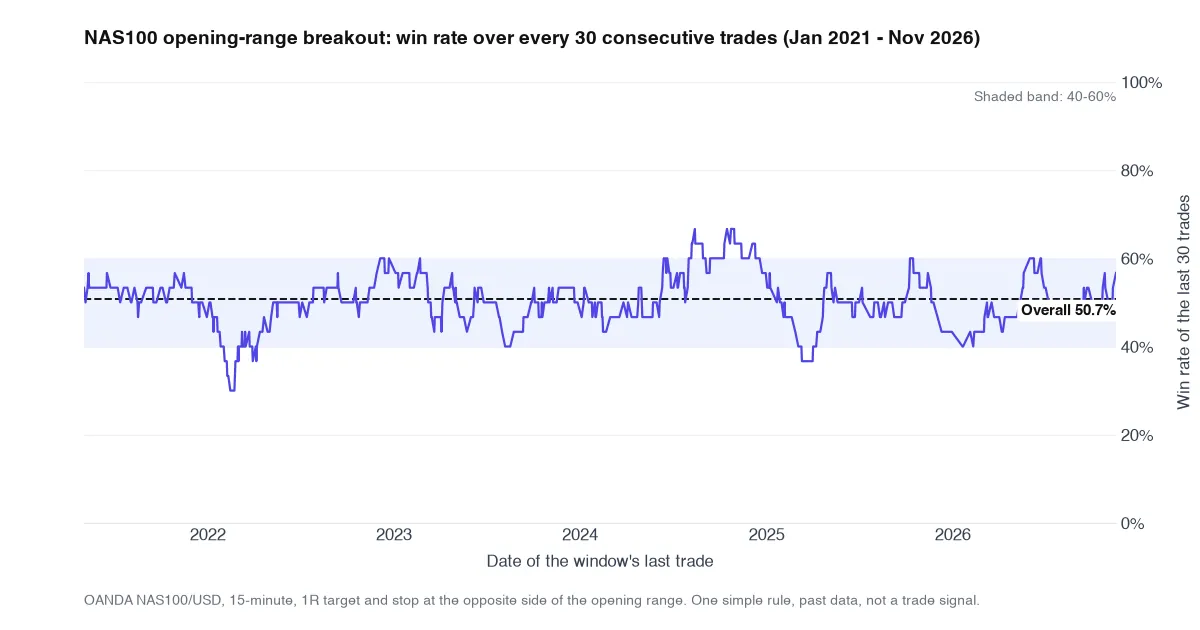
We tested this gap directly, on paper trading rather than live demo trading, but the sample-size problem is identical: one plain NAS100 rule, tested across 529 overlapping windows of 30 trades, swung from a 30% win rate to a 67% win rate with the rule never changing. Thirty trades, whether on a demo account or on paper, is a coin flip you can easily mistake for skill. Confidence should come from evidence, not from a good couple of weeks on demo. That evidence only shows up once you run the rule against years of history, not a few weeks of practice.
Backtest your rule before you demo trade it
Demo Account vs Paper Trading: Is There a Difference?
Mostly in where the tracking lives. A broker's demo account streams its own live prices and logs trades inside that broker's platform. Paper trading usually means running the same practice, with virtual money, on your own tracked journal or a simulator built for exactly that, so every entry, exit, and result is recorded in one place you can actually review later rather than scattered across whichever broker you happened to demo with that month.
- A demo account ties you to one broker's feed and platform.
- A paper trading log follows you across brokers and instruments.
- Both answer the same question: can you follow your own rules without real money on the line.
Demo Trading Journals: Why Logging Still Matters
A demo balance resets or expires. A written log of what you actually did does not. The habit worth building on demo is not the platform clicks, it is the log: entry, exit, size, the reason for the trade, and one honest line on how you felt taking it. That log is what turns a demo account from a video game into evidence you can look back on, and it is the same habit a paper trading journal forces you to build properly.
- Entry price, exit price, and position size, not just win or lose.
- The rule or setup you were following, in one line.
- How you felt pulling the trigger, especially on the trades you almost skipped.

Common Mistakes That Waste a Demo Account
A demo account is cheap to use and easy to waste. The mistakes below cost nothing in money and everything in the lesson you were supposed to learn.
- Starting with an unrealistic balance. A $100,000 default balance when you plan to trade $2,000 live teaches you to size positions that do not transfer to your real account.
- Trading without written rules. If nothing is at stake and there is no rule to follow, there is nothing to actually test. You are just clicking.
- Going live after one good week. A short winning streak on a small sample is hope wearing a confident jacket, not evidence.
- Quitting after one bad week. Same problem, opposite direction. One bad streak on a small sample tells you almost nothing either way.
- Treating it like a game. The discipline you practise on demo is the only part of the experience built to carry over. Skip it, and the account is just a screen with fake numbers on it.
What to Check in a Broker's Demo Terms
Before you trust a single trade from it, read the fine print on the demo itself:
- No deposit required to open it, and no card details asked for upfront.
- A clearly stated expiry date, not a silent reset that wipes your log.
- Leverage and margin rules that match, or clearly disclose how they differ from, the live account.
- The same execution venue and platform as the live account, not a separate generic simulator.
Choosing a Demo Account Worth Using
Not every demo account is built the same, and the differences matter more than people expect.
- Same broker, same platform. If you plan to go live with a specific broker, demo on that broker's own platform, not a generic simulator with different spreads and execution.
- A realistic virtual balance. Set it to what you will actually risk, not whatever default the broker hands you.
- Matching leverage and spread. Ask whether the demo server mirrors the live account's leverage and typical spread, or whether it is deliberately more generous to look good.
- No expiry that resets your sample, and a way to review your history. Some demo accounts expire after 30 days and wipe your log, which punishes the one thing you actually need: a continuous record of trades you can look back on.
None of this is about finding the "best" demo account. It is about picking one that will not quietly lie to you about your own results.
What Happens When You Switch From Demo to a Funded Account
Whether you are moving to your own live account or a funded prop account, the switch exposes anything the demo was quietly hiding. Position sizing that felt automatic on demo suddenly needs a real calculation. A drawdown rule that never got tested, because the account never actually dropped that far on demo, becomes the first thing to break. The platform transfers cleanly. The habits around risk do not transfer on their own, they have to be rebuilt on the first real sample of live trades.
- Re-check your position sizing against the funded account's actual rules, not your demo defaults.
- Confirm the drawdown and daily loss limits before your first live trade, not after a breach.
- Expect the first week to feel harder than the best weeks on demo. That is normal, not a sign the rule is broken.

How Long Should You Demo Trade Before Going Live?
Most brokers suggest a few weeks. The honest answer is: count trades, not days. If your rule only triggers a few times a week, a few weeks on demo is not a sample, it is a glimpse. Use the demo account to get comfortable with the platform and your own order of operations, then build a bigger sample with paper trading or backtesting before you size up with real money. The platform is the easy part to learn. Knowing whether your rule survives contact with a real sample is the part worth getting right first.
A few signs you are actually ready to move off demo, rather than just bored of it:
- You can place, log and review a trade without checking the platform's help menu.
- You have a written rule, not a feeling, for every trade you take.
- You have tested that rule on a sample large enough to mean something, by paper trading or backtesting it, not just a few demo weeks.
- You are sizing from your real budget and your real stop distance, not the demo default.
For the full walkthrough of building that sample properly, see how to paper trade: a step-by-step guide. More guides, plus the backtesting tools, are on the Traders Journal blog.