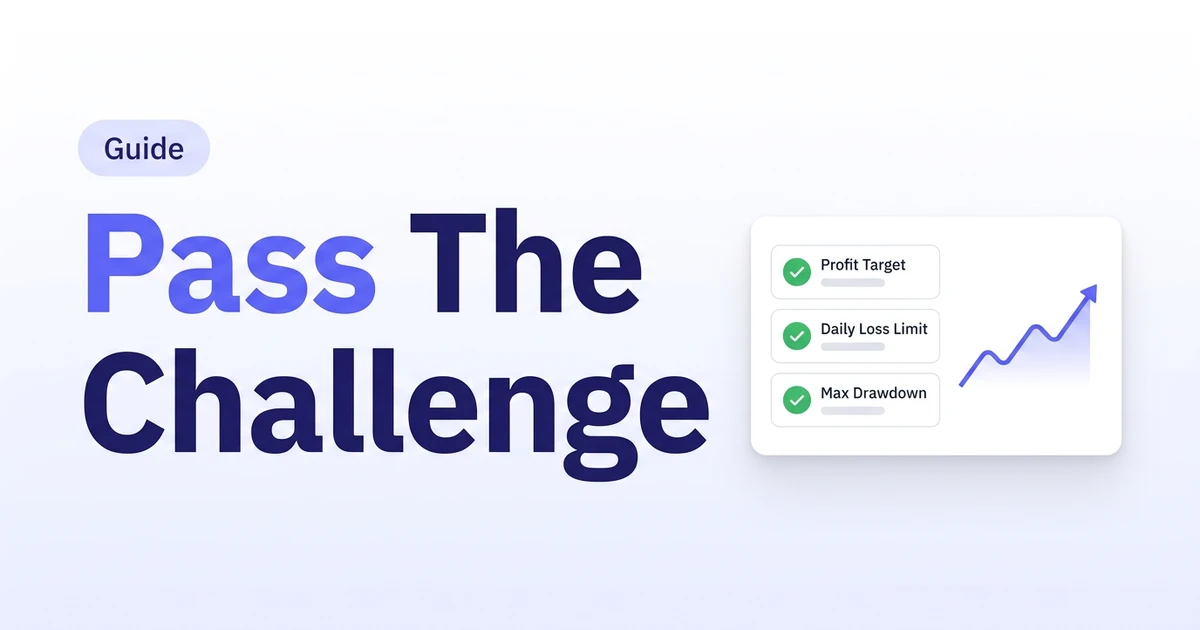
A prop firm challenge is a paid test on a demo account. Hit a profit target without breaking a daily loss limit or a maximum drawdown, and the firm offers you a funded account to trade with a profit split. Miss any one rule, even on a winning trade, and the attempt is over. It is not about how often you are right. It is about not breaking the rules while you are right often enough.
Most people fail on the rules, not the market. A day up 3% followed by a day down 6% breaches a 5% daily loss limit even though the week is still green. That is what this guide is about: the rules that end attempts, the risk maths that keeps you inside them, and a real test we ran on 969 simulated attempts to show how often one ordinary rule passes or breaches.
The short version, if you are in a hurry:
- Read your firm's exact numbers first: target, daily loss limit, max drawdown, minimum days, consistency rule.
- Find out whether the drawdown is static or trailing. It changes how much risk you can afford.
- Work backward from the loss limits to a risk per trade. Do not work forward from the profit target.
- Backtest your exact rule first, so you know its worst drop and longest losing streak before you pay.
- Trade the tested rule only. Stop for the day after one or two losses.

What Is a Prop Firm Challenge?
A proprietary (prop) trading firm lends you its capital to trade, in exchange for a cut of the profit. Before it hands that capital over, it wants proof you will not blow it up in a week. The challenge is that proof: a simulated account, usually $10,000 to $200,000, that you trade under fixed rules for a set period, sometimes unlimited. Pass, and the firm moves you to a funded stage with a profit split, commonly somewhere around 60/40 to 90/10 in the trader's favor, depending on the firm and plan.
You never risk your own trading capital on the challenge itself. You pay a one-time fee for the attempt, and that fee is what you lose if you breach a rule. The capital in the account is the firm's, not yours, win or lose.
How a Prop Firm Challenge Works
Most firms run one of two structures. A one-step challenge asks for a single profit target, then funds you. A two-step challenge (sometimes called an evaluation) splits it into two phases, usually with a bigger target in phase one and a smaller one in phase two, both under the same daily and max drawdown limits throughout.
- Buy the challenge. Pick an account size and pay the one-time fee. You get a demo login and a rulebook. Read the rulebook before you read anything else.
- Trade phase one to the profit target. Commonly 8% to 10% of the starting balance, with no day in breach of the daily loss limit along the way.
- Trade phase two, if the firm uses one. A smaller target, often 4% to 5%, under the same limits. Some one-step firms skip this and fund you straight from phase one.
- Get funded. The firm moves you to a funded account, simulated or live, still under drawdown rules, now with a real payout on profit.
One-Step, Two-Step, or Instant Funding: Which to Pick
Firms now sell three shapes of the same test, and the shape changes how much room you have to be wrong. Instant funding skips the evaluation balance entirely: you pay more up front and trade a funded account from day one, usually at a lower profit split and a tighter drawdown limit until you have banked a few profitable weeks.
| Format | What you prove | Trade-off |
|---|---|---|
| One-step | A single profit target, once, under full drawdown limits | Fastest to funded, least room for a rough patch |
| Two-step | The same target split across two smaller phases | More time overall, but you clear the bar twice |
| Instant funding | Nothing upfront, funded from day one | Higher fee, usually a lower starting split and tighter drawdown until proven |
None of the three changes the maths in the sections below. The daily loss limit, max drawdown and position sizing still decide whether an attempt survives a bad week, whichever format sits on top of them. Pick the format that matches how much time you actually have to trade it properly, not the one with the cheapest fee.
The Rules That Actually Get People Disqualified
Four rules show up on almost every firm's sheet, worded slightly differently each time. Learn the exact numbers for your own firm before you trade. These are the common ranges, not a universal standard.
| Rule | Typical range | Why it ends attempts |
|---|---|---|
| Profit target | 8% to 10% (phase 1), 4% to 5% (phase 2) | The number you are actually being tested against. |
| Daily loss limit | 4% to 5% of the starting balance | One bad day can end the challenge even in a green week. |
| Maximum drawdown | 8% to 10% total, static or trailing | Caps how far the account can fall before the challenge closes. |
| Minimum trading days / consistency | Often 3 to 10 minimum days, some cap single-day profit share | Stops one lucky trade from carrying the whole result. |
Read the daily loss limit carefully. Some firms measure it from the starting balance, others from the previous day's closing balance, and many count open (floating) losses too, not just closed trades. That difference changes how much room you really have left after a winning day. The consistency rule works the same way: a few firms void a pass if one single trade produced most of the profit, which punishes exactly the "one lucky trade" result a tight stop and small size are meant to avoid in the first place.
Static vs Trailing Drawdown: The Rule That Changes Your Risk
The max drawdown comes in two flavours, and they are not the same rule. A static drawdown is a fixed floor. On a $100,000 account with a 10% limit, the floor is $90,000, and it never moves. A trailing drawdown follows your best balance up. Make $5,000 and the floor rises to $95,000, so a pullback that a static limit would shrug off can end the attempt.
| Static | Trailing | |
|---|---|---|
| Floor on a $100,000 account, 10% limit | $90,000, always | 10% below your highest balance |
| After a +$5,000 run | Still $90,000 | Rises to $95,000 |
| What it punishes | Slow bleed from the start | Giving back profit from any peak |
| How to size for it | Plan for the full 10% as runway | Plan for a much smaller pullback from each high |
Some firms stop the trail once you reach a set profit, and some measure it on equity rather than balance. Both are details to find in the rulebook before you pay. Below, we put a number on how much harder the trailing version is.
Start free, no card
Log every trade, tag your setups and see what's working. The free plan stays free.
We Ran a Real Rule Through the Challenge 969 Times
Every guide says "manage your risk." Few show what that does to the odds. So we took one plain rule, ran it through a simulated challenge, and counted. The rule is the same NAS100 opening-range rule from our paper trading data: take the first 15-minute candle, starting between 10:00 and 11:15 New York time, that closes outside the opening 30-minute range, put the stop on the other side of the range, and aim for a profit equal to the risk (1R). On OANDA 15-minute candles from 4 January 2021 to 17 November 2026, that gave 969 setups. Trades that hit neither stop nor target were closed at the 16:00 New York close at their real result. Across all 969, the rule made +37.5R, about +0.04R a trade.
The challenge: a $100,000 account, a +10% profit target, a 5% daily loss limit and a 10% static maximum loss, with 30 calendar days to finish. We started one attempt on every setup date, 969 attempts in all, and traded every later setup in order at a fixed percent risk. The first rule broken ended the attempt.
| Risk per trade | Passed | Breached | Timed out |
|---|---|---|---|
| 1% | 0 of 969 (0%) | 0 (0%) | 969 (100%) |
| 2% | 69 (7.1%) | 24 (2.5%) | 876 (90.4%) |
| 3% | 238 of 969 (24.6%) | 133 (13.7%) | 598 (61.7%) |
| 5% | 189 (19.5%) | 777 (80.2%) | 3 (0.3%) |
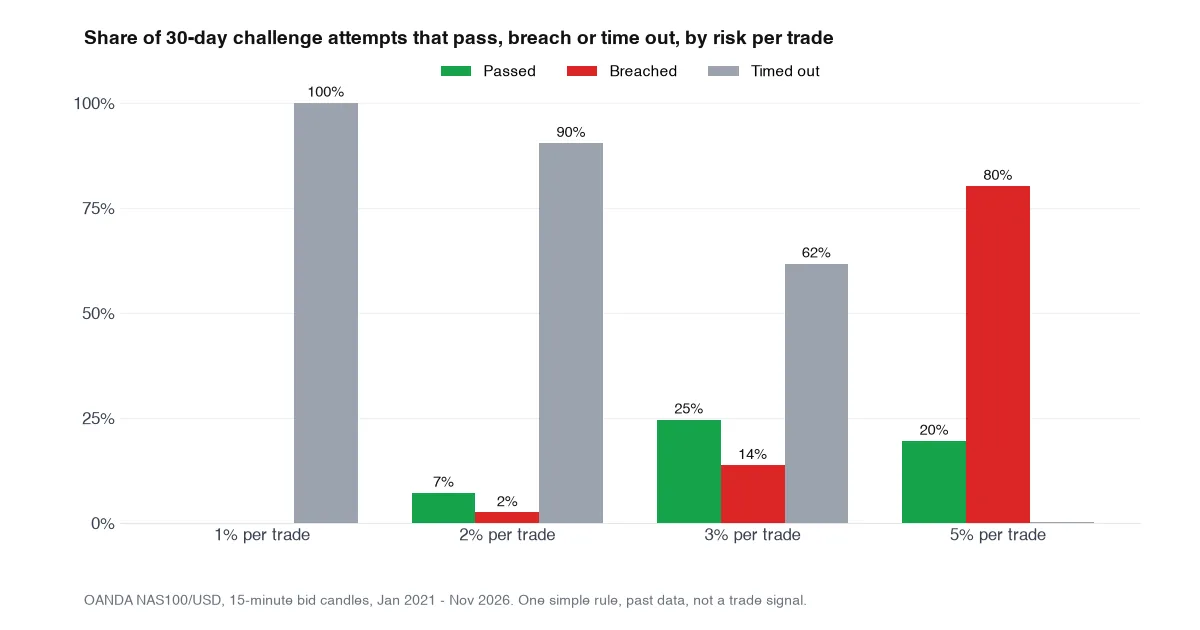
Read the table row by row, because each one teaches something different.
- 1% risk: safe and too slow. Zero breaches, zero passes. The best 30 days in the whole sample netted +9.3R, which is +9.3% at 1% risk. The target was just out of reach every single time.
- 3% risk: 238 of 969 passed, 133 breached. That is about one attempt in four passing and one in seven blowing up, on a rule with a real edge. Nobody tells you the breach column is that big.
- 5% risk: the daily limit does the killing. A single full loss is exactly 5% of the account, so 777 attempts ended on a first losing trade. The 189 that passed strung wins together before a loss arrived.
The point is not that 3% is right. It is the trade-off. The risk small enough to protect you cannot hit a 10% target on a 30-day clock with this rule, and the risk big enough to hit it breaches roughly one time in seven. Choose the risk from the rulebook and the clock together, never from how confident you feel.
What Changes When There Is No Time Limit
Many modern challenges have no deadline on the target. Same rule, same attempts, no 30-day clock:
| Risk per trade | Passed | Breached | Median days to pass | Still open Nov 2026 |
|---|---|---|---|---|
| 1% | 638 (97.4% of finished) | 17 (2.6%) | 306 | 314 |
| 2% | 691 (76.4%) | 214 (23.6%) | 95 | 64 |
| 3% | 640 (67.2%) | 313 (32.8%) | 42 | 16 |
With time on your side, 1% almost never breaches: 17 of 655 finished attempts. It just takes a median of 306 calendar days to get there, because the rule only earns about 0.04R a trade. Double the risk and a quarter of attempts breach. Triple it and a third do. Percentages here count only attempts that finished before the data ended, so treat them as a guide, not a forecast. The lesson holds: time is a risk-free way to buy safety, if the firm lets you spend it and you can stay patient.
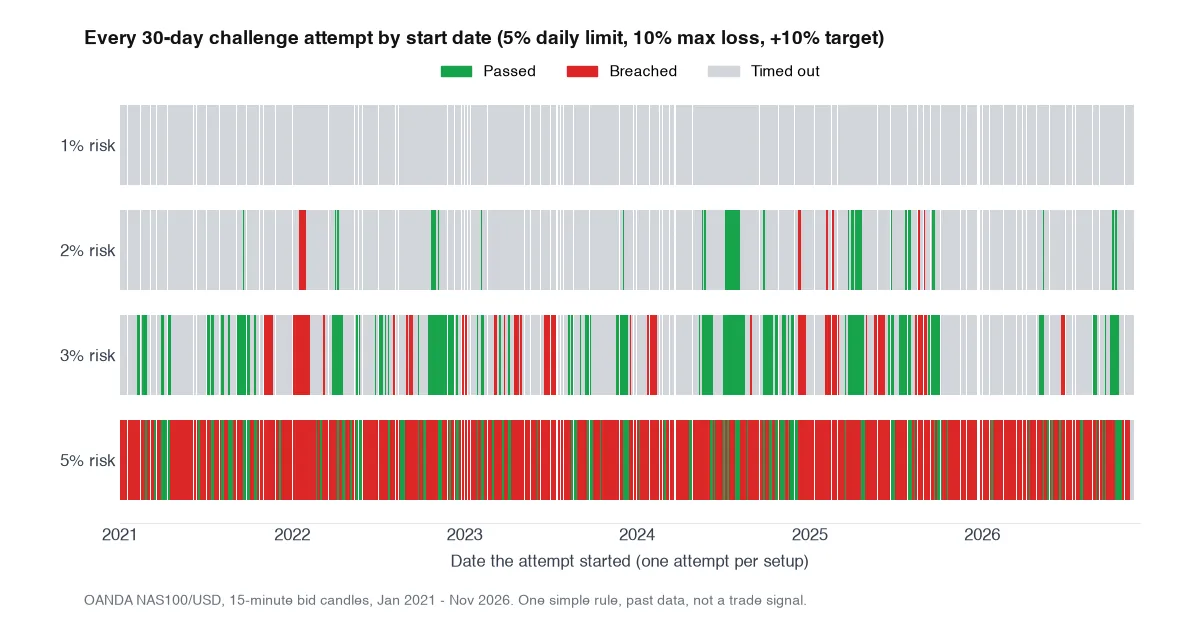
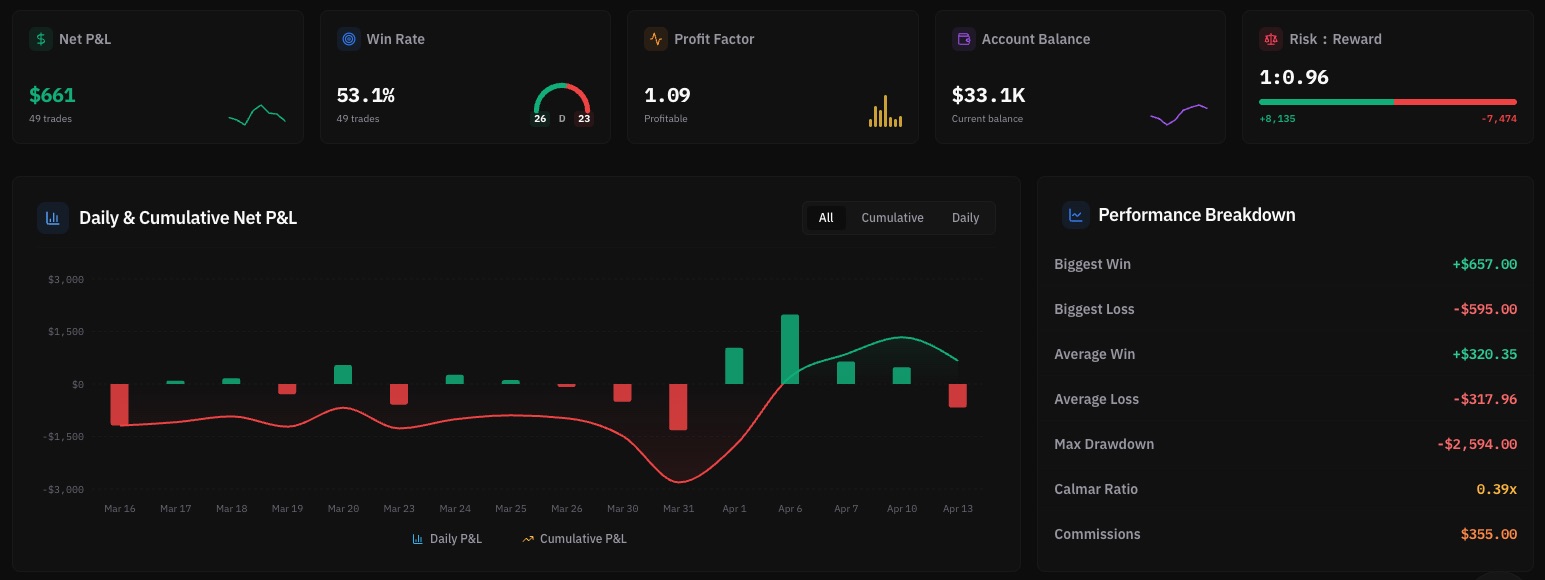
The strip chart shows the other thing a table hides: timing. Passes and breaches arrive in clusters, because the same winning or losing stretch hits every attempt that starts near it. Start a challenge at the wrong time and you get the bad stretch whatever your skill. That is luck, and a single attempt cannot tell luck from edge.
Same Rule, Same Risk, a Trailing Drawdown
Now swap only the drawdown rule. Keep the 5% daily limit and a 10% maximum loss, but make the 10% trail the highest balance instead of staying fixed. No time limit.
| Risk per trade | Static 10% breached | Trailing 10% breached |
|---|---|---|
| 1% | 17 of 655 finished (2.6%) | 133 of 678 finished (19.6%) |
| 2% | 214 of 905 finished (23.6%) | 410 of 932 finished (44.0%) |
Same trades, same risk, and the breach rate jumps from 2.6% to 19.6% at 1% risk. At 2% it nearly doubles to 44%. A trailing drawdown does not care that you are profitable overall. It only cares how far you fell from your last high. If your firm trails, size smaller: in our test a trailing limit at 1% risk breached about as often as a static limit at 2%.
The Worst Stretch Is Longer Than You Think
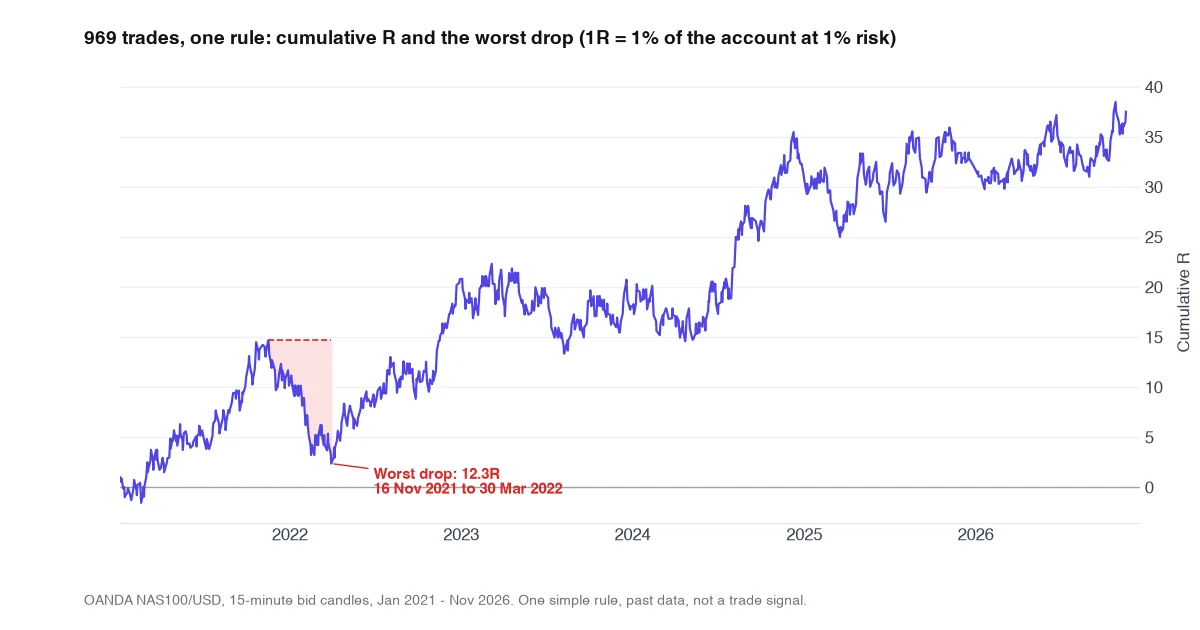
The rule finished the period up 37.5R. It did not get there in a straight line. Between 16 November 2021 and 30 March 2022 it gave back 12.3R from peak to trough, and its longest run was seven losing trades in a row. At 1% risk, 12.3R is a 12.3% drop. That is bigger than a 10% trailing limit and bigger than a 10% static one measured from a high. A rule that ends the year profitable can still fail a challenge in its worst quarter.
That is exactly the number you want before you pay: your rule's worst drop and its longest losing streak. We cover how to get them in the backtest section below.
Our test, OANDA NAS100/USD 15-minute bid prices, no spread, commission, slippage or news rule. Win is +1R, loss is -1R (stop first, or both in one candle counts as a loss), and trades that hit neither were closed at the 16:00 New York close at their real result. Risk is a fixed percent of the starting balance. Attempts overlap, so they are not independent samples. It shows how one simple rule meets one set of challenge rules, not a strategy to copy.
Start free, no card
Log every trade, tag your setups and see what's working. The free plan stays free.
Risk Per Trade: Work Backward From the Limits
Work backward from the loss limits, not forward from how big a trade feels comfortable. Ask two questions. How many losses in a row can the account take before the maximum drawdown closes it? How many losses in one day before the daily limit does? The answers decide your risk per trade.
| Risk per trade | Losses in a row to reach a 10% max loss | Losses in one day to reach a 5% daily limit |
|---|---|---|
| 0.5% | 20 | 10 |
| 1% | 10 | 5 |
| 2% | 5 | 3 |
| 3% | 4 | 2 |
| 5% | 2 | 1 |
Now set that against reality. Our NAS100 rule had a longest losing run of seven trades. At 2% risk, seven in a row is 14%, comfortably past a 10% limit. At 1% it is 7%, survivable. That one comparison is worth more than any "risk 1% and you will be fine" slogan, because it uses the streak your own rule actually produced.
| Account size | Daily loss limit (5%) | Risk per trade at 1% | Losing trades before the daily limit |
|---|---|---|---|
| $10,000 | $500 | $100 | 5 |
| $50,000 | $2,500 | $500 | 5 |
| $100,000 | $5,000 | $1,000 | 5 |
The dollar figures scale with the account. The ratio does not. That is the point of a fixed percent: it gives you the same number of mistakes to survive on any account size.
Backtest Your Plan Before You Pay for an Attempt
Most prop firm guides tell you to "have a trading plan" and leave it there. The plan is not the hard part. The hard part is knowing, before you pay the fee, whether your entry rule and stop actually fit inside that firm's loss limits over enough trades to mean something. A handful of demo trades this week will not tell you that. A backtest across real history will.
Backtest your entry and stop against real history, free
That is what our backtesting tool is for. Run your exact rule across up to 15 years of history on roughly 30 instruments, including forex, futures, metals and indices, and read the numbers that decide a challenge:
- Max drawdown. Compare it to the firm's limit. If it already sits near the limit, the rule does not fit that firm.
- Longest losing streak. Multiply it by your risk per trade. That is the drop you must survive.
- Average R and win rate together. A low win rate with a big payoff can pass. A high win rate with tiny winners can still lose.
- Trades per month. It tells you how long a 10% target will take at your risk, before the firm's clock does.
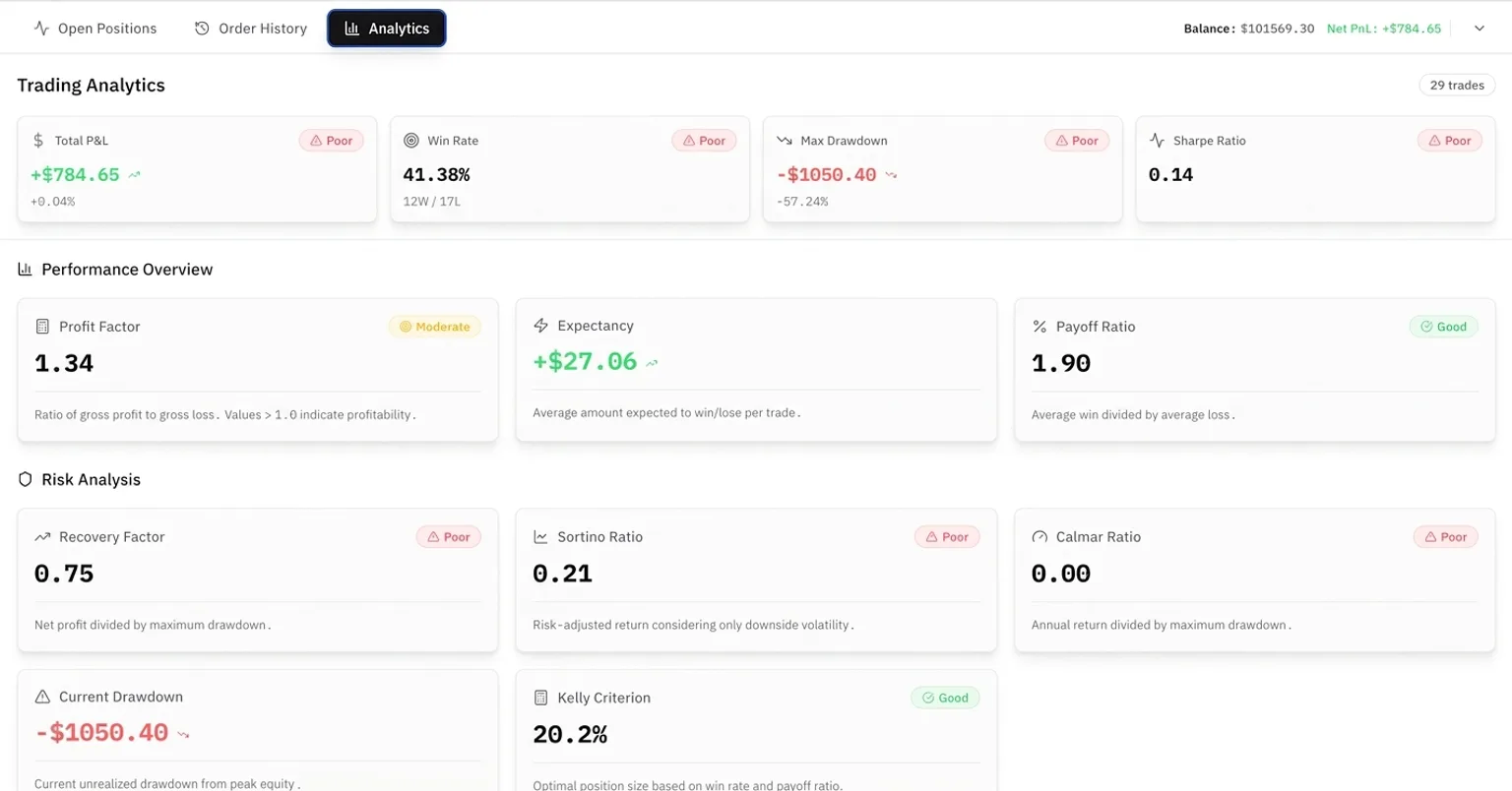
Honestly, the firms know most attempts fail on rule breaches, not on bad ideas. Spending an evening testing the plan against the firm's own numbers before you pay is the cheapest insurance there is. If you would rather feel the rule first, rehearse it as well. Our guide on how to paper trade shows how to do that with real sizing and a log.
A Step-by-Step Plan to Pass
- Write the rules on one page. Target, daily limit, max drawdown (static or trailing), minimum days, consistency rule, news and weekend rules, inactivity limit. If you cannot fill a line, read the rulebook again.
- Pick one setup. One market, one rule. Five setups split across a short challenge is five untested rules.
- Backtest it. Record the max drawdown, the longest losing streak and the average trades per month.
- Choose the risk from the limits. Use the table above. Take the smaller of what the daily limit and the max drawdown allow.
- Check the pace. Divide the target by your average R per trade and your risk. That is roughly how many trades you need. If the firm's clock is shorter than your rule's pace, pick a different firm or a different rule. Do not raise the risk.
- Rehearse under the exact limits. Run a demo with the firm's numbers set as hard stops. Fix any rule you break before you pay for a real attempt.
- Trade the challenge like a job. Same rule, same size, one or two trades a day, a log after each. Bank the minimum days without forcing them.
- Stop at the target. When you hit it, stop. Extra trades now only add risk to a result you already have.
Why Most People Fail a Challenge
- Sizing up to hit the target faster. Most modern challenges have no deadline on the target. The daily loss limit does not care how close you are to passing. Our 5% risk row shows how that ends.
- Ignoring the trailing drawdown. Sizing for a static floor on a trailing account is how a profitable week ends an attempt.
- Trading through high-impact news without checking the rule. Some firms restrict or ban it. Breaching that rule voids a pass even on a profitable trade.
- Revenge trading after a loss. One oversized trade to "get it back" turns a green week into a breached daily limit by lunch.
- Not knowing how the daily limit resets. Starting balance or prior close, closed P&L or floating P&L. Guessing wrong costs the attempt.
- Treating the demo money as not real. It is not your money, but the fee is. Trade it like the account you are trying to earn.
- Rushing the minimum days. A fast pass on three lucky trades is the result the consistency rule exists to catch.
- Changing the rule mid-attempt. A new idea under pressure is an untested rule. Save it for a demo account that is not on the clock.
A Simple Daily Routine for Challenge Days
- Check your remaining daily loss room first, before the first trade. Know the exact dollar figure you cannot cross today, not a rough feeling of it.
- Trade only the setup you backtested. Anything else is a new rule on the clock.
- Size from the stop, every trade, no exceptions. Decide the dollar risk first, then size backward from the stop distance.
- Stop for the day after one or two losses, even with room left. A string of losses is often a read that today is not your day, not a reason to double the next one.
- Log the trade and the running drawdown. You want to see the drawdown number creeping up before the firm's dashboard tells you it is close.
What Happens After You Pass
Passing moves you to a funded account, not out of the rules. Most firms keep the same daily loss limit and max drawdown in place, now against a profit split that typically starts around 60/40 to 80/20 and can scale higher with consistent months. Payouts are usually processed on a schedule, commonly every two to four weeks, once you request one and meet the firm's minimum trading day requirement for that cycle.
Scaling plans vary by firm, but the shape is the same everywhere: trade a few consistent, profitable cycles without breaching a rule, and the firm raises your buying power. Breach a rule at any stage, funded included, and most firms close the account the same way the challenge would have. So do not change your rule on day one of the funded stage. The thing that passed is the thing to keep trading.
How to Choose a Prop Firm
Firms differ mainly on four things: the fee for the account size you want, the exact daily loss and drawdown numbers, whether the challenge has a time limit, and the profit split and payout schedule once funded. A slightly cheaper fee is not worth it if the drawdown rule is tighter than one your strategy can actually live inside, which is the thing your backtest should already have told you.
| Check before you pay | Why it matters |
|---|---|
| Static or trailing drawdown | A trailing floor raised our breach rate sharply at the same risk |
| Time limit on the target | Decides how much risk your rule needs to finish |
| Daily limit: balance or equity, start or prior close | Sets your real room after a winning day |
| News, weekend and EA or copy-trading rules | Breaching one voids a pass even on a profit |
| Fee refund and retry discounts | Many firms refund the fee on a first payout, terms vary |
| Scaling plan and payout schedule | Fixed schedule or earned after consistent cycles |
| Inactivity rule | Some close an account after 7 to 30 days with no trades |
Before you pick one, make sure the plan you intend to trade survives its numbers on paper. Our guides on how to backtest a trading strategy and how to paper trade cover the two steps worth doing before you pay for any challenge: prove the rule on history, then rehearse it without the pressure of a live clock. Do that and the fee buys you a real shot, not a lottery ticket. More guides like this one live on the Traders Journal blog.