
I started trading near the end of 2020. I kept the capital small and refused to scale until I found some edge. I made mistakes, but I tried not to pay heavily for the same one twice. Traders Journal came out of that: it is the tool I kept wishing existed while I was fixing those mistakes.
This is the short, honest version of why it exists, how it got built, and where it is going. It is not a ranking, and it does not say we are the best at anything.
Start free, no card
Log every trade, tag your setups and see what's working. The free plan stays free.
The Problem With My Excel Journal
Around 2021 I logged entries, exits and thoughts in Excel. It calculated my ratios fine. What it could not do was show me what I saw on the chart when I took the trade. A row that says "long, +1.2R" tells you nothing about why you entered late.
So I moved to a private chat where every trade came with a screenshot, an annotation and the reason behind it. That worked, and it was also a mess to search. Context mattered more than the P&L, and none of my tools stored both. If you are weighing journals right now, the best free trading journal apps compared lays out what each free plan really includes.
Why Backtesting Came Next
By 2022 I had bought courses, followed the rules properly, and sat slightly above breakeven for a few months. Then progress flattened. Following a strategy was not enough. I needed to know its normal drawdown, the market conditions where it was weak, and which trades were worth skipping.
Backtesting gave me that. It did not make the strategy permanent. It showed me when the rules had evidence and when they did not. If that idea is new, start with what backtesting actually is.
My journal kept showing the same pattern: the strategy was fine, my execution was not. Missed entries, late fills, wider stops. A journal tells you what happened. A backtest tells you what the rules would have done. I wanted both in the same place, not in two tabs and a spreadsheet.
How It Got Built
The idea started in 2024: one place for journaling, backtesting, charting and, eventually, automation. An agency took the project on and struggled with how many moving parts it had. Delays piled up.
I am not from a technical background. Replit made it possible to build it myself. I started in April 2025 and launched the first version around June.
Start free, no card
Log every trade, tag your setups and see what's working. The free plan stays free.
Version One Was Small
The first version had a dashboard and journaling, nothing else. Early community users mostly praised it. That felt good and taught me very little, because many were beginners and useful criticism is hard to get from people who do not yet know what is missing.
So I kept using it on my own trades and kept fixing what annoyed me. Praise is not the same as insight.
What It Does Today
- Journaling: log trades, attach screenshots and tags, and write the reason behind each one. The free trading journal is the best place to start.
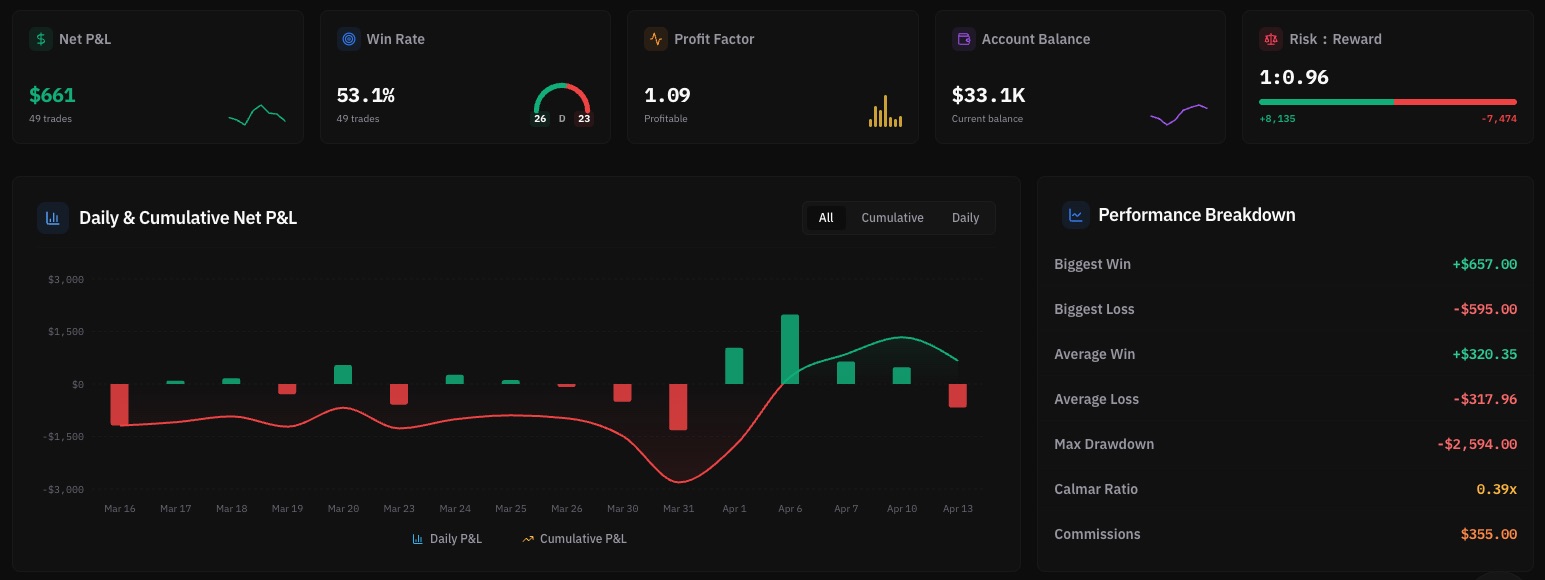
- Analytics: a dashboard and trade statistics so you can see where you repeat mistakes.
- Charts and replay: live charts plus bar replay, so you can step through a setup candle by candle.
- Backtesting: run a strategy on historical data and review it like a trade log. See the backtesting workspace.
It starts free. Premium is $12 a month or $119 a year with a 21-day trial. Compare the full list on the pricing page.
Where It Is Going
Automation is the piece still being built. By 2023 my own journal showed that execution was hurting otherwise useful strategies, so rule-based automation is the natural next step. It is limited today and expanding, so I will not oversell it here. I would rather ship it properly than announce it early.
Who It Is For (and Who It Is Not)
Traders who want to journal, test ideas and review trades in one place: forex, futures, stocks, crypto and Indian markets. If you want maximum tick-level replay realism for a single market, a dedicated simulator may suit you better, and we say so in our Forex Tester comparison. If you mainly want to compare no-code tools, start with the best no-code backtesting software.
Journaling and backtesting will not make a strategy profitable. They help you spot your mistakes, test an idea before live risk, and keep a cleaner review process. If that sounds useful, you can start with the free plan and see whether it fits how you trade.