Every trader has a strategy that "works." Ask them for the ten backtested trades that prove it and the room goes quiet.
That gap — between "I think this works" and "here's the evidence" — is exactly what backtesting closes. It won't tell you a strategy will make money. It will tell you whether your confidence in it is earned or just vibes wearing a trading plan. If you would rather run one than read about it, try free backtesting software with bar replay.
Start free, no card
Practice on real price history and live charts with fake money, and find out what works before it costs you a rupee or a dollar.
What Is Backtesting? (Short Answer)
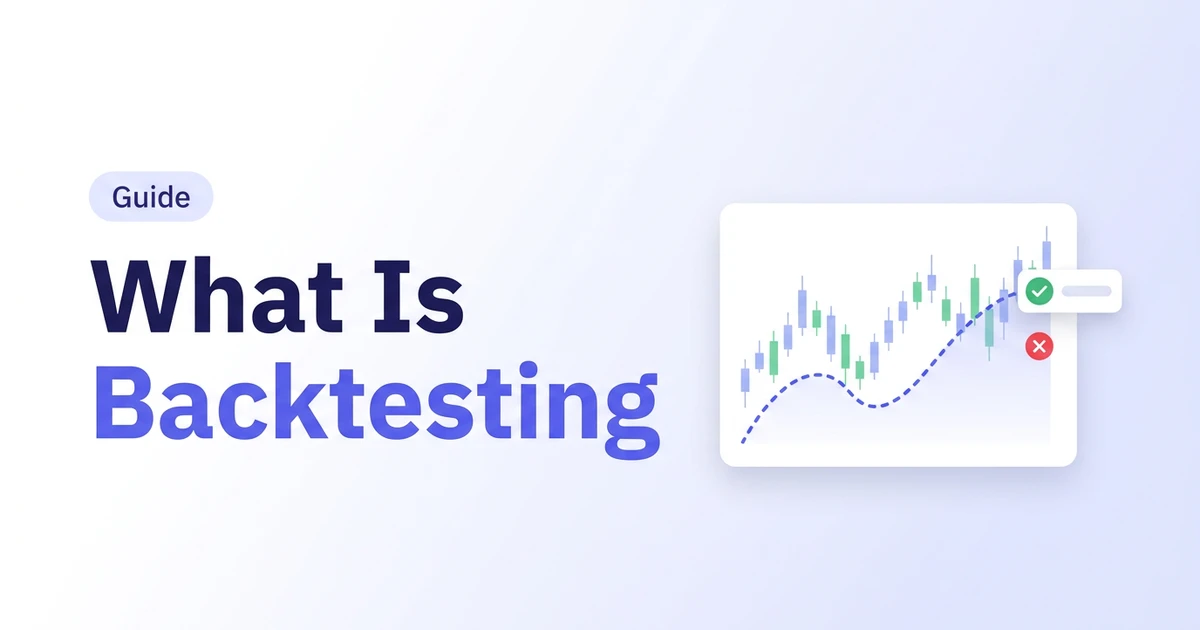
Backtesting is running a trading strategy's exact entry, exit, and risk rules against historical price data to see how it would have performed, without risking real money.
Backtesting meaning, in one line: write the rules first, then let old charts grade them. Not the other way around.
The word gets used loosely. "Backtested" (also written "back-tested") should mean the strategy ran against a fixed, pre-written rule set over historical data. It does not mean "I looked at some old charts and this setup seemed to work a lot."
Why Backtesting Matters
Look — most losing strategies don't fail because the trader was careless. They fail because nobody checked if the idea had evidence behind it before real money went in.
Backtesting is required before risking serious money. It can't predict the future — no test on old data can — but it can expose weak rules and false confidence while the cost of being wrong is just your time, not your account.
Following a strategy from a course or a YouTube video was never enough for me. I needed to know its normal drawdown, which market conditions it struggled in, and which of its "textbook" setups were actually worth taking. Backtesting is what gave me that. It didn't make the strategy permanent — nothing does — but it showed me exactly when the rules had evidence behind them and when they didn't.
That's the real value: not proof of future profit, but proof you're not just guessing with extra steps.
How Backtesting Works
Four moves. Write the rules down exactly, with entry, exit, stop and position size. Pick a market, timeframe and enough data to cover trending, ranging and quiet periods. Run the rules and log every signal, winners and losers. Then read the numbers together. For the full walkthrough with no code, see how to backtest a trading strategy step by step.
Platform-specific? Here is how to backtest on TradingView, or how to read the MT4 backtesting report. Testing several strategies at once changes the math, which portfolio backtesting covers.
Manual vs Automated Backtesting
Manual backtesting means scrolling through historical bars and logging each signal yourself. It is slow, but you learn to see the setup. Automated backtesting means software replays the data and applies your rules for you, so you get through hundreds of trades in the time manual testing gets you through twenty.
Most traders do both: manual first to learn the setup, software once they trust the rules and want a real sample. Our roundup of no-code backtesting software covers the tools that do the heavy lifting.
What a Backtest Report Shows
Win rate alone means nothing. A 70% win rate with losers five times the size of winners still loses money. Read these together:
| Measure | What it tells you |
|---|---|
| Win rate | How often trades hit target |
| Average R | Average gain or loss per trade, measured in units of risk |
| Profit factor | Gross profit divided by gross loss. Above 1 means it made more than it lost. Try the profit factor calculator |
| Max drawdown | The deepest drop from a peak, which is what you have to sit through |
| Longest losing streak | How many losses in a row the rules produced |
| Sharpe ratio | Return per unit of volatility, mostly used by funds |
A Simple Backtesting Example
Numbers make this less abstract. Say the rules are:
- Buy when the 20 EMA crosses above the 50 EMA on the daily chart.
- Stop loss at the most recent swing low.
- Target at 2x the risk (a 1:2 risk-to-reward).
- Exit early if price closes back below the 20 EMA before hitting either level.
Run that against five years of one instrument and, say, it generates 240 signals. 96 hit target, 120 hit the stop, and 24 got closed early on the EMA rule. That's a 40% win rate — sounds mediocre on its own.
But at 1:2 risk-to-reward, 40% wins is profitable: 96 wins × 2R minus 144 losses × 1R still nets +48R across 240 trades. The profit factor, drawdown across the worst 12-month stretch, and how the strategy did in the flat, choppy years versus the trending ones all matter more than the headline win rate. That's the whole point of running the numbers instead of trusting the "feels like it works" version.
This is arithmetic, not a recommendation. Run your own rules on your own market and see what comes back.
Start free, no card
Practice on real price history and live charts with fake money, and find out what works before it costs you a rupee or a dollar.
Who Uses Backtesting
Everyone from quant funds to retail traders. CFA Institute's research found half of the investment professionals surveyed had run a backtest on a strategy in the past 12 months. Funds backtest models before allocating capital. Retail traders backtest to find out if a setup from a course or a video has evidence behind it. Same job, smaller budget.
Backtesting vs Paper Trading vs Forward Testing
These three get used interchangeably. They're not the same check, and each one catches something the others miss.
| Method | Data used | What it catches |
|---|---|---|
| Backtesting | Historical data, all at once | Whether the rules have any statistical edge at all |
| Paper trading | Live prices, no real money | Whether you can actually follow the rules in real time |
| Forward testing | New data, after the backtest was built | Whether the edge survives outside the data it was tuned on |
| Scenario analysis | Hypothetical what-if shocks, not real history | How the strategy copes with events that never happened in your data |
A strategy that passes a backtest but falls apart on a paper trading simulator usually has an execution problem, not a rules problem — the trader is hesitating, over-riding, or moving stops. A strategy that passes both but fades in forward testing usually means the backtest found a pattern in noise, not a real edge.
Run all three in order and each one is a cheaper filter than the next. A weak backtest costs you an afternoon. A weak paper-trading stretch costs you a few weeks of attention. Skipping straight to live trading because the backtest looked good costs you the thing you were trying to protect in the first place.
What Backtesting Can't Tell You
Backtesting relies on the idea that a strategy which performed well on past data will likely perform well going forward. That assumption has real limits, and pretending it doesn't is how good backtests turn into bad live accounts.
- It can't predict the future. Past performance is evidence, not a guarantee. Markets change as participants, technology, and conditions change — a rule set built on 2019 volatility doesn't automatically survive whatever regime shows up next.
- It's easy to overfit without noticing. Keep adding filters until the equity curve looks perfect, and you've usually built a strategy that only works on the data you tested it on. Every extra condition that was added after looking at the results is one more way the strategy has learned the past by heart instead of finding a real edge. Researchers have quantified exactly how badly this inflates results — the more parameters you tune to fit the past, the less the numbers mean going forward.
- Look-ahead bias sneaks in. Using information that wouldn't have been available at the time — like knowing today's close while "backtesting" today's open — quietly inflates results. It's rarely intentional. It's just easy to do by accident with the wrong data feed or a sloppy script.
- Survivorship bias hides the failures. If your test data only includes stocks or funds that still exist today, the ones that collapsed are missing, and results look better than they were.
- It doesn't test you. A backtest has no fear, no greed, and no hesitation. Live execution adds all three, and that's usually where a good backtest quietly stops mattering.
None of this means don't backtest. It means treat a passed backtest as a starting point, not a verdict.
A backtest tells you whether the idea has evidence. It cannot tell you whether you will follow the rules when real money and real fear show up.
How Many Trades Do You Actually Need?
Ten good trades prove very little. With a small sample you can't tell a real edge from a lucky streak.
We ran the test. In our simulation of a strategy with no edge (33.3% win rate at a 2R target, true profit factor 1.0), 16.6% of 30-trade samples still showed a profit factor of 1.5 or better, against 0.3% of 200-trade samples. Same strategy, same zero edge. Only the sample size changed.
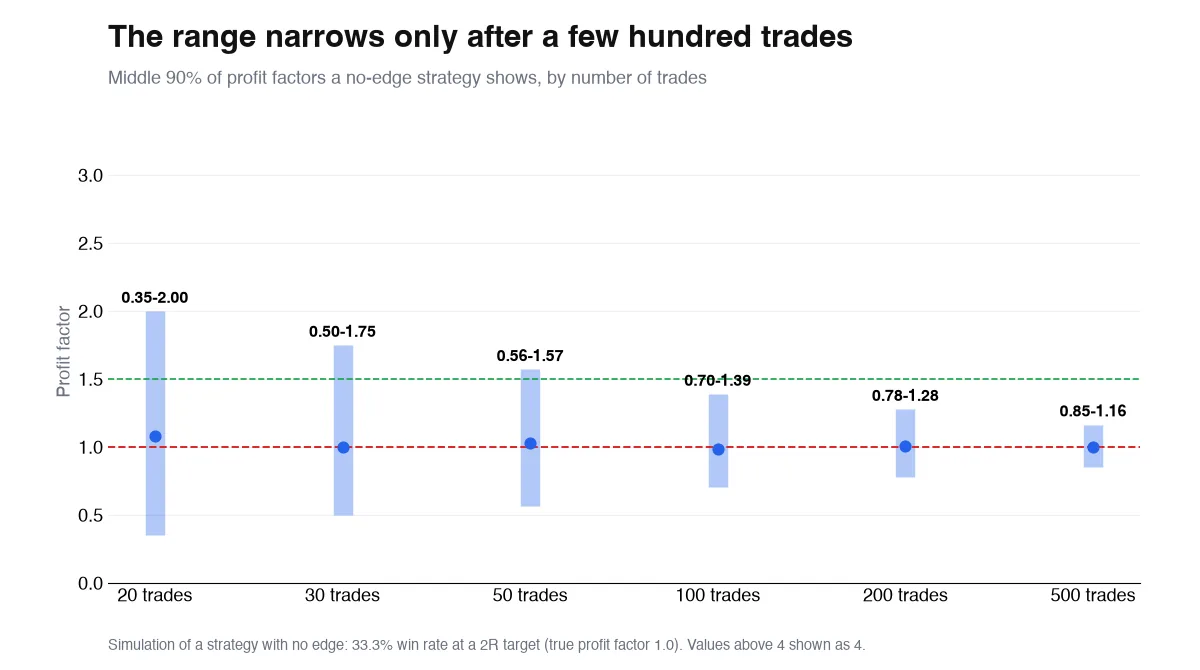
If your profit factor sits inside that range for your trade count, you can't yet tell it apart from luck. Check yours with the profit factor calculator, then replay hundreds of trades in the Traders Journal backtesting workspace to get past the noise.
Test across different market conditions too. A strategy that only met one calm uptrend hasn't been tested. It's been flattered.
Common Backtesting Mistakes
- Changing the rules mid-test. If a rule shifts because a trade didn't work out, you're not backtesting a strategy anymore. You're backtesting hindsight, and hindsight always wins.
- Ignoring costs and slippage. A strategy that barely wins after fees usually loses once real spreads and slippage show up. Model costs in from the first run, not as an afterthought once the equity curve already looks good.
- Testing on too small or too clean a sample. One trending quarter is not a market cycle. Neither is one instrument — a strategy that only works on one specific pair or stock might be exploiting something that has nothing to do with the rules.
- Skipping the losing trades in the review. If your backtest log only has winners, congratulations — you invented fiction. The losers are where the real information lives.
- Treating a passed backtest as permission to go all-in. A good backtest is not the finish line. Start small live, and let real execution prove it too, before position size catches up to conviction.
How Traders Journal Helps
Backtesting is boring until it saves you from donating real money to a strategy that only worked in your head. A dedicated tool helps more than a blank spreadsheet.
We built a trading journal to keep charting, journaling and backtesting in one place instead of five tabs. Backtest with bar replay across roughly 30 instruments (Indian indices, index futures, metals, forex and crypto) with up to 15 years of historical data. Log the trades it generates straight into your journal and review the stats without rebuilding a spreadsheet. Roughly 3,600+ traders use it, and together they've created over 35,000 workspaces.
There's a free forever plan to start, and Premium is $12/month. None of it promises profit; nothing honestly can. It turns "I think this strategy works" into something you can check. For the steps, start with our step-by-step backtesting guide.
Test your rules before you risk money
For the record-keeping side once you go live, see what a trading journal actually is.